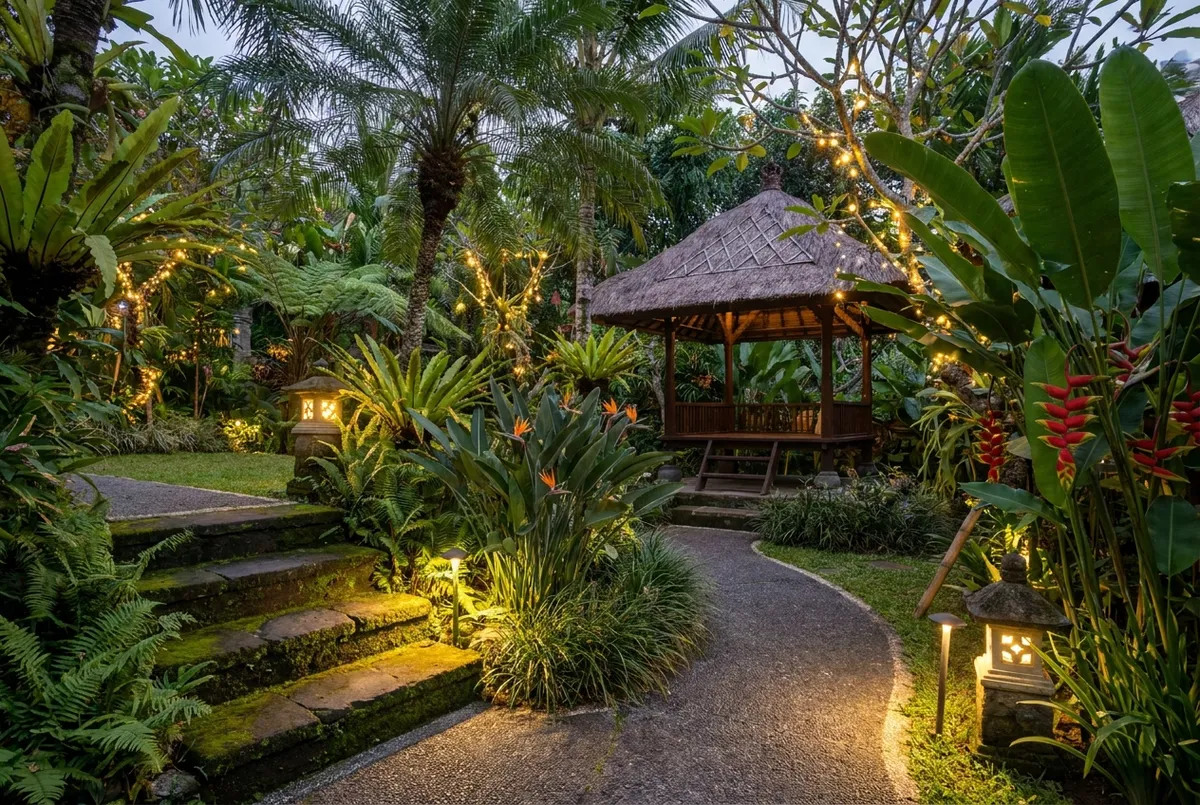
Bali evenings are long, warm and dark by 6:30 pm year-round — yet most villa gardens vanish at sunset behind one glaring wall floodlight. Good garden lighting works the opposite way: low-voltage warm LEDs placed low and aimed carefully, so you see glowing frangipani branches and lit paths rather than the fixtures themselves. After 15 years of building gardens I add lighting plans to almost every project now, because owners consistently tell me it changed how much they use the garden more than any plant ever did. And in this climate, how it is wired matters as much as how it looks — wet season finds every bad connection by January.
What We Design and Install
Path & Step Lights
Low bollards and recessed step lights that guide guests safely from gate to door to pool — light on the ground, not in anyone's eyes.
Uplights for Trees & Walls
Ground-spiked uplights grazing frangipani trunks, palms and textured stone walls — the layer that gives a garden depth at night.
Pool & Entertaining Areas
Warm ambient light around decks and dining bales, dimmable where it matters, with fittings rated for splash zones.
Safe Power & Controls
12–24V systems with IP67 connections, cable buried in conduit, proper transformers and dusk timers — installed to survive the wet season, not just the handover photo.
Why Low-Voltage, and Why Wiring Quality Decides Everything
We install 12–24V LED systems for villa gardens for three reasons. Safety: low voltage in a garden full of water, irrigation and barefoot guests is simply the right call. Running cost: a full garden scheme often draws less than a single old halogen floodlight. And flexibility: fittings can be moved as plants grow — and plants do grow, which is why we design lighting and planting together whenever we can, and rough in cabling during landscaping builds while trenches are open.
The failures we get called to fix are almost never the lamps — they are connections taped instead of gel-sealed, cable laid an inch under mulch where a hoe finds it, transformers mounted where rain pools. Every joint we make is IP67-sealed, every run is in buried conduit, and the transformer lives somewhere genuinely dry. It is the unglamorous half of the trade and the reason our systems still work in February. For evening-use gardens we also tune the scheme around the pool — see pool surroundings & hardscape — where reflections on water do half the aesthetic work for free.
How We Work
Evening photos or a night visit
Send photos of the garden and tell us how you use it after dark. For bigger schemes we visit at dusk.
Lighting plan and demo
A fixture plan with a fixed quote — and for full schemes we can demo key positions with temporary lights before you commit.
Installation
Trenching, conduit, fittings and transformer — most villa gardens take 1–3 days with minimal disturbance to planting.
Aiming at night
The step everyone skips: we return after dark to aim and dim every fitting properly, then hand over timer controls.
What It Costs
A starter scheme — path lights plus a few uplights on a dusk timer — starts from IDR 2,500,000 installed. A full villa garden scheme of 15–25 fittings with zoned control typically lands between IDR 8,000,000 and 20,000,000 depending on fixtures and cable runs. Repairs to existing systems start from IDR 350,000 — guide rates on the pricing page.
Before You Book: FAQ
Is garden lighting safe around pools and irrigation?
Will it survive the rainy season?
How much does garden lighting cost to run?
Can you add lighting to an established garden?
Garden Care Coverage in South Bali
See Your Garden After Dark
Send a few photos and how you use the garden in the evening — we sketch a lighting plan and price it the same day.
Get a Lighting Quote